Tag: Enbridge Line 5

There is no such thing as a free lunch – or a free tunnel.

Every day, hundreds of thousands of barrels of crude oil and natural gas liquids (NGLs) flow across the Straits of Mackinac through two 20-inch pipelines that have proven vulnerable to anchors dropped by passing freighters and barges. There’s a broad consensus for the need to remove the aging pipelines and reduce the risk of a catastrophic oil spill in one of the world’s most environmentally sensitive areas.

The solution proposed by Enbridge, the Canadian owner of the pipelines, is to build a tunnel, 21-feet in diameter and four miles long, deep below the Straits of Mackinac. The tunnel would enclose a new pipeline, making it less vulnerable than it is today.

The cost? Likely $2 billion – to be paid by consumers.

In an era of rising costs with consumer pain over the high cost of gas in particular, it would be reasonable and prudent to look for another, less costly delivery solution.

Energy security after Line 5.
Two exhaustive studies by PLG, one of the world’s leading pipeline and logistical consultancies with deep analytical expertise, have identified solutions that would reduce costs for both Enbridge and consumers while completely obviating any future environmental risks.

PLG identified a range of replacement options that are both “commercially viable and operationally feasible.”

Enbridge’s Lakehead System is a complex web of energy infrastructure transporting 36 million barrels of through more than 1900 miles of pipelines, with 20 major terminals, 200 tanks, and over 600 pumping systems.

First constructed more than 70 years ago, Line 5 is part of Enbridge’s Lakehead System, a network of pipelines in the Great Lakes region. It is fed by Enbridge pipelines originating in Western Canada.
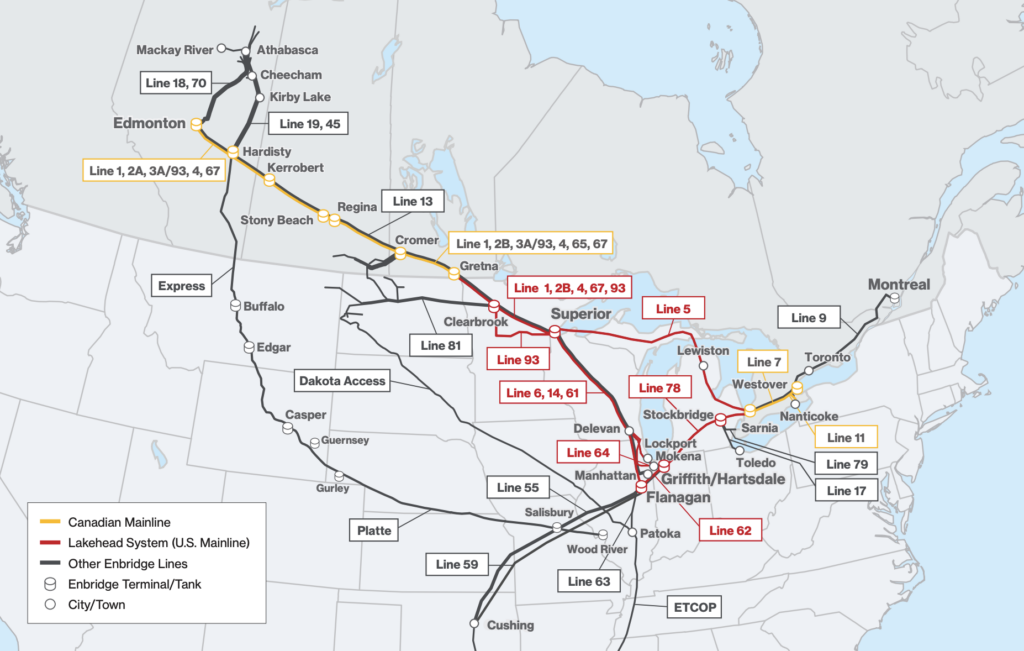
SOURCE: https://www.enbridge.com/~/media/Enb/Documents/Factsheets/FS_ENB_Mainline_system.p

Line 5 transports between 400,000 and 450,000 barrels per day (bpd) of crude oil, in addition to about 80,000 bpd of NGLs east from Superior, Wisconsin, to Sarnia, Ontario. At least 88% of Line 5 crude oil is delivered to Canada

PGL concluded:

“Based upon careful research as well as PLG’s more than 15 years of consulting experience in energy supply chains and logistics, our analysis demonstrates that energy markets will adapt – as they have always done and continue to do – in the event that Line 5 is shut down. With advance notice, the markets can be expected to do so without supply shortages or price spikes.”

The reality is that if Line 5 were to shut down tomorrow, the vast North American pipeline system would recalibrate “and would not materially affect the affordability or market competitiveness of product delivered to any given Line 5 destination area.”

Recall, the dire predictions of widespread energy shortages accompanying the disruption of energy supplies resulting from the Russian invasion of Ukraine in February 2022. The immediate response included recalibration of the European energy system and the near immediate phase out of EU dependence on Russian gas, oil and coal.

Canada is considering a new pipeline to avoid the Great Lakes — and the United States.

The Canadian government is actively exploring a new pipeline corridor wholly on Canadian soil that would connect Alberta production directly to Sarnia, bypassing the Great Lakes entirely. This alternative would accomplish Enbridge’s stated objective — delivering crude to Sarnia refineries — without running a high-risk line across Michigan and the Straits of Mackinac, or spending billions on a tunnel under the Great Lakes.

The fact that Canada is seriously studying this option undercuts the claim that Line 5 is irreplaceable. If a domestic Canadian route is technically and economically feasible—and Ottawa’s interest suggests it is—then doubling down on the construction of a contested, geotechnically challenged tunnel becomes even harder to justify.

Enbridge acknowledges that the “tunnel solution” is temporary.

Enbridge itself acknowledges that the “tunnel solution” is temporary. In a filing to the U.S. Federal Energy Regulatory Commission, the company sought to shorten (“truncate”) depreciation schedules for its U.S. energy infrastructure. The deprecation schedule is important because it sets a time horizon for when the tunnel becomes an essentially worthless asset. Enbridge’s stated reasons are telling: “current and anticipated competition to the Enbridge Mainline,” “actions by state and local governments,” and “the uncertainty arising from the recent acceleration” of decarbonization laws and policies in both the U.S. and Canada.

Electric vehicle adoption is reducing oil demand as well. The International Energy Agency forecasts that electric vehicles will displace more than 5 mb/d by 2030.

In plain terms, Enbridge has informed regulators that long-term demand for its pipelines is uncertain and increasingly constrained by policy and market changes. That admission directly contradicts any narrative that Line 5 — and especially a massive new tunnel project — is an essential, long-term energy asset. If Enbridge expects its mainline infrastructure to face declining utilization and competitive pressure, why should regulators or consumers underwrite an expensive new tunnel that is likely to be underused well before its engineered lifespan expires?

We will all pay for the tunnel.

Finally, consumers will ultimately pay for the avoidable $2 billion cost of the tunnel. Pipeline companies recover capital expenditures on infrastructure like the tunnel through tariffs — fees that are embedded in the price of gasoline, diesel, jet fuel, and home heating fuels and passed on and paid by the end-user: you. A multibillion-dollar tunnel that is not critical for regional energy security is, in effect, a privately directed but consumer-funded infrastructure project.

In a market that already enjoys ample supply, multiple alternative routes, and strong redundancy, forcing households, small businesses, and industrial users to finance an unnecessary tunnel is neither reasonable nor prudent. Those dollars could instead support grid modernization, energy efficiency, electrification, or genuinely forward-looking infrastructure that aligns with evolving decarbonization policies.

Taken together, the evidence points to a clear conclusion: Line 5 is not a lynchpin of North American energy security. The integrated, surplus-rich, and highly adaptable North American pipeline system already in place can reliably serve the Great Lakes region without the dangerous Line 5 shortcut and the tunnel. With viable Canadian alternatives emerging, Enbridge’s own acknowledgment that its assets face declining long-term demand, and a hefty price tag that would be borne by consumers, the proposed Line 5 tunnel is not just riskyit is unnecessary.

Flow senior advisor Stanley “Skip” Pruss was the former director of the Michigan Department of Energy, Labor, and Economic Growth; and the State’s Chief Energy Officer under former Gov. Jennifer Granholm.  Earlier in his career, Skip served as Deputy Director of the Michigan Department of Environmental Quality.
Flow statement on U.S. Army Corps tunnel permit

Fast-tracked under a January 2025 presidential executive order declaring a trumped-up “energy emergency,” the U.S. Army Corps of Engineers has announced its decision to approve the Canadian company Enbridge’s pipeline tunnel through Lake Michigan at the Straits of Mackinac. The proposed tunnel would house the Enbridge Line 5 pipelines, which terminate in Sarnia, Ontario, and primarily serve eastern Canada.

The tunnel project can not move forward, however, without a permit from the Michigan Public Service Commission (MPSC) — which the Michigan Supreme Court struck down in a 6-1 ruling.

The Army Corps approval was made possible by the Whitmer administration’s recent approval of two EGLE permits. The Corps approved the project despite its own findings (PDF) that it would result in both short- and long-term detrimental impacts, including permanent wetland and wildlife habitat losses; potential release of drilling fluids to ground and surface waters; up to six years of construction noise, lights, traffic, and vibrations; limits to recreational activities; destruction of archeological resources; and housing values and tourism.

Flow Water Advocates anticipated that the Army Corps would rubber-stamp this project, because the Corps relied on the same conveniently narrow analysis of the project that was just struck down by the Michigan Supreme Court. In our recent victory in FLOW v. MPSC and the parallel Tribal coalition case, the Court vacated the MPSC permit and ordered it to complete a comprehensive analysis of the environmental and public trust impacts, and fairly compare feasible and prudent alternatives.

Live webinar: A Deep Dive on Line 5

WEBINAR: Thursday, August 20 at 12:00pm EDT

Enbridge’s Line 5 pipeline and proposed tunnel in the Straits of Mackinac threaten the Great Lakes, while primarily serving Canada. In July, the Tribal and environmental coalition earned a significant victory when the Michigan Supreme Court vacated a required state permit for the tunnel project. Meanwhile, additional state and federal permit processes continue to play out, as the Line 5 issue shapes the important November election.

Join Flow Water Advocates and Oil & Water Don’t Mix on August 20 at Noon for a live webinar, A Deep Dive on Line 5, as we unpack what it all means, what happens next, and how you can help get oil out of the Great Lakes.

Our expert panel includes:

  • Riyaz Kanji, founding member and Directing Attorney of Kanji & Katzen – representing the Bad River Band of Lake Superior Chippewa and Flow Water Advocates
  • Debbie Chizewer, Managing Attorney, EarthJustice 
  • David Holtz, Oil & Water Don’t Mix Campaign Coordinator and member of the Sierra Club Board of Directors

Hosted and moderated by Flow executive director Liz Kirkwood.

About the panelists

Riyaz Kanji, Founding Member and Directing Attorney, Kanji & Katzen

Riyaz Kanji is a founding member of Kanji & Katzen, PLLC, a firm whose mission is to advance Tribal sovereignty. A graduate of Harvard College and the Yale Law School, Riyaz served as a law clerk to the late Honorable Betty Fletcher of the United States Court of Appeals for the Ninth Circuit and Justice David Souter of the United States Supreme Court. He is an advisor to and vocal cheerleader for the Tribal Supreme Court Project. Riyaz represents Tribes at all levels of the federal court system, and was part of the team that argued and won the decision in McGirt v. Oklahoma vindicating the continued existence of the Muscogee Creek Reservation. Riyaz served as lead attorney for Flow Water Advocates in its recent successful appeal to the Michigan Supreme Court, FLOW v. MPSC, which vacated the Line 5 tunnel permit issued by the Michigan Public Service Commission.

Debbie Chizewer, Managing Attorney, EarthJustice

As the managing attorney for Earthjustice’s Chicago office, Debbie Chizewer has built a Midwest team and a docket of cases across three program areas — climate and energy, healthy communities, and wild lands and wildlife. This team’s work includes representation of Tribal Nations in the fight against the risky Line 5 oil pipeline and advocacy on behalf of Black, low-income communities facing disproportionate environmental harms from air and water pollution. Throughout her career, Debbie has advocated for environmental protection across many issues — fighting for environmental justice in the Midwest at Northwestern Law’s environmental law clinic, promoting Great Lakes health at the Alliance for the Great Lakes, and protecting wildlife and public lands in the Rockies for the National Wildlife Federation. Debbie graduated from Princeton University and Boston University School of Law. After graduation from law school, she clerked in the U.S. District Court in the District of Delaware.

David Holtz, Coalition Coordinator for Oil & Water Don't Mix and Member of the Sierra Club Board of Directors

David’s passion for environmental protection, social justice and belief in people-powered political change led him to become a Sierra Club volunteer and in 2013 join the campaign to shut down Enbridge’s dangerous Line 5 oil pipeline in the Straits of Mackinac. He currently serves as coalition coordinator for Oil & Water Don’t Mix. David is a member of the national Sierra Club Board of Directors where he serves on the board’s Executive Committee. For more than a decade David worked as a newspaper reporter and is a former senior aide to a Member of Congress from Michigan. David was a founding board member of the nonprofit communications hub, Progress Michigan, and served as its executive director from 2010 to 2013 and is the former Michigan Director for Clean Water Action. He is a U.S. Marine Corps Vietnam veteran.

Flow v. MPSC: MI Supreme Court issues Line 5 tunnel permit decision

FOR IMMEDIATE RELEASE: July 31, 2026

Michigan Supreme Court upholds the public’s rights to the Great Lakes, orders new review of Line 5 tunnel. 

Traverse City, Mich., July 31, 2026 — The Michigan Supreme Court ruled that Michigan regulators failed to properly weigh the Great Lakes’ public trust protections and environmental impacts before approving Enbridge Energy’s proposed Line 5 tunnel beneath the Straits of Mackinac. The Court overturned the Michigan Public Service Commission’s (“MPSC”) approval of the project and sent the case back to the agency for further review of public trust and environmental impacts — a major victory for Flow Water Advocates (“Flow”) and its Tribal and environmental co-appellants.

The ruling resolved the consolidated appeals brought by Flow, four federally recognized Tribes – the Little Traverse Bay Band of Odawa Indians, Bay Mills Indian Community, Grand Traverse Band of Ottawa and Chippewa Indians, and Nottawaseppi Huron Band of the Potawatomi – and the Environmental Law and Policy Center and the Michigan Climate Action Network, all of whom challenged the MPSC’s approval of the tunnel.

The High Court found that the Court of Appeals erred in this case “by applying a deferential standard of review to the MPSC’s decision, and the MPSC erred by (1) failing to consider whether the tunnel project will factually and proximately cause the extension of Line 5’s operational life, potentially resulting in additional environmental harm; (2) comparing alternatives in an inconsistent manner; and (3) failing to consider the project’s impact on public trust resources.” The Court rejected the Court of Appeals’ ruling that the MPSC lacked the authority to apply a common-law public trust analysis, stating, “We agree with FLOW and hold that MEPA requires separate consideration of harms to public trust resources.”

Lead attorney, Riyaz Kanji, remarked, “Today the Michigan Supreme Court vindicated the rights of every Michigander to the protection of the Great Lakes. It reaffirmed that the invaluable waters of the Great Lakes and submerged lands beneath them are held by the state for the benefit of the people, and that the public’s rights in those vital waters and lands cannot be given away to private interests like Enbridge without careful consideration of the environmental impacts and alternatives. The High Court made clear that regulators and state agencies, like the MPSC, which has authority over the location and operation of pipelines and other utilities, cannot avoid this fundamental duty to the public in their permit decisions.” 

Flow’s Executive Director, Liz Kirkwood, said, “This decision of the Michigan Supreme Court builds on a long lineage of public trust case law and affirms that the public trust doctrine and the Michigan Environmental Protection Act (“MEPA”) are alive and well in Michigan. Today’s historic ruling cements the importance of the MEPA and the common-law public trust doctrine in agency permitting decisions affecting the waters and natural resources of the people of Michigan. The MPSC cannot greenlight the tunnel project until the agency actually determines its impact on the public’s rights to the Great Lakes waters and the lands beneath them — and weighs that harm against the alternatives, as the law requires.”

Flow is represented in this case by its legal team and co-counsel, Kanji & Katzen, P.L.L.C. and Olson & Howard, P.C.

Flow Water Advocates statement on Whitmer administration’s Line 5 tunnel permit decisions.

FOR IMMEDIATE RELEASE: July 15, 2026

TRAVERSE CITY, Mich. — In a pair of key permit decisions announced today by the Michigan Department of Environment, Great Lakes, and Energy (EGLE) regarding Enbridge’s proposed pipeline tunnel through the Straits of Mackinac, the state has failed to carry out its duties under the Michigan Wetlands Protection Act (Part 303), the Great Lakes Submerged Lands Act (Part 325), and the Public Trust Doctrine to protect Michigan wetlands and submerged lands. It has also disregarded over 70,000 public comments EGLE received during the public comment period last summer and instead sided with Enbridge and its pipeline that ends in Sarnia, Ontario and primarily delivers crude oil to Canada.

“That these heartbreaking permit decisions were announced during a period of dangerously bad air quality due to climate change-related wildfires is sadly poetic,” said Liz Kirkwood, Flow Water Advocates executive director. “It’s a stark illustration that building this tunnel and further entrenching the burning of fossil fuels isn’t just wrong for the Straits and Michiganders, it’s wrong for the planet.”

Flow Water Advocates holds that under the Great Lakes Submerged Lands Act, the tunnel project cannot be lawfully permitted unless the state has found that adverse effects to the environment and public trust are minimal, and that there are no feasible and prudent alternatives to the applicant’s proposed activity (in this case, Enbridge’s proposal to bore a 4.5-mile tunnel through the Straits).

No such finding has been made, and feasible alternatives — including utilizing excess capacity elsewhere in pipeline and rail networks, as detailed in a pair of reports by energy supply chain analysts PLG Consulting (Likely Market Responses to a Potential Shutdown of Line 5 (2023), Prospective Line 5 Closure Boosts US Energy Dominance (2025)) — are available. The decisions are particularly egregious given the fact that feasible and prudent alternatives are also identified in the state’s own record.

And just last week, the CBC reported that Ontario Premier Doug Ford and Alberta Premier Danielle Smith are backing a new “Northern Shield” oil pipeline that would stretch from Western Canada to Sarnia, bypassing the U.S. and the Great Lakes. Last fall, the Ontario government began a feasibility study for the project, which would bolster Canadian energy independence — and potentially render Enbridge’s Line 5 and proposed tunnel redundant.

In joint comments submitted to EGLE, Flow Water Advocates, the Sierra Club, and Surfrider Foundation wrote “Enbridge’s pursuit of the Line 5 tunnel runs in direct contradiction to the public interest in Michigan’s invaluable freshwater resources and the ecosystems they support; in the sacred cultural sites within and surrounding the Straits and the Tribal rights that are inextricably tied to them; in a healthy climate future and a resilient Michigan economy; and in the vested rights of all Michiganders to use and enjoy the State’s public trust resources free from the threat of substantial impairment.”

The permit approvals announced today are a blow to Michigan’s public trust resources, Tribal rights and interests, and Governor Whitmer’s own Healthy Climate Plan and commitment to carbon neutrality.

Enbridge cannot begin construction of this proposed tunnel under the Great Lakes until it has secured final approval for two other major permits, including the National Pollutant Discharge Elimination System (NPDES) permit from EGLE, and the federal permit from the U.S. Army Corps of Engineers. A permit issued by the Michigan Public Service Commission (MPSC) has been appealed to the Michigan Supreme Court by Flow Water Advocates (For Love of Water v. MPSC) and a coalition of tribal nations joined by the Environmental Law & Policy Center and Michigan Climate Action Network (Little Traverse Bay Bands v. MPSC). A decision is expected in late July.

###

Flow Water Advocates is an independent 501(c)(3) nonprofit organization based in Traverse City, Michigan. Our mission is to ensure the waters of the Great Lakes Basin are healthy, public, and protected for all. With a staff of legal and policy experts, strategic communicators, and community builders, Flow is a trusted resource for Great Lakes advocates. We help communities, businesses, agencies, and governments make informed policy decisions and protect public trust rights to water. Learn more at www.FlowWaterAdvocates.org.

Deep concerns raised at Line 5 tunnel public hearing

Last week, over 200 participants gathered over Zoom for the public hearing on the proposed reissuance of the National Pollutant Discharge Elimination System Individual Permit (NPDES) for Enbridge’s proposed Line 5 tunnel through the Straits of Mackinac. 

Line 5 is a pair of aging oil pipelines that travels across the bottom of the Straits of Mackinac, where Lake Michigan meets Lake Huron. Enbridge, the Canadian company that owns Line 5, is proposing to replace the Line 5 pipelines with a tunnel that will be bored underneath the lakebed. The U.S. Army Corp. of Engineers (USACE) found that the tunnel will result in detrimental impacts, including loss of wetlands and wildlife habitats; potential release of drilling fluids; construction noise, lights, traffic, and vibrations; limits to recreational resources; and impacts to property values and tourism.

Enbridge is requesting a reissuance of the now-expired NPDES permit that the Michigan Department of Environment, Great Lakes, and Energy (EGLE) granted in 2021. If re-approved, the permit would allow Enbridge to dump massive amounts of warm waste water into Lake Michigan, take up to 2 million gallons of water per day from Lake Michigan, and discharge unknown toxic chemicals into the water as a result of the tunnel boring. The proposed draft permit and other related documents can be found here

Out of the 200+ participants at last week’s hearing, around 90 people spoke up and gave public comments in support or opposition to the NPDES permit. EGLE took comments for nearly 6 hours, as the hearing stretched on until almost midnight.

A majority of commenters opposed the permit, noting an array of concerns, including the lack of information on what chemicals Enbridge will be using for water treatment; Enbridge’s lack of trust and various failures at Line 3 in Minnesota and Line 6B in Kalamazoo; the company’s lack of good will in Wisconsin over the Bad River Band territory; concerns on the cultural impact to Indigenous Peoples and safety concerns about the construction camps near Indigenous lands, among others. Folks in attendance also highlighted concerns regarding the safety of dumping potentially contaminated wastewater into Lake Michigan, with several commenters noting that the temperature limit for wastewater as established in the permit was too high for the Great Lake’s cold water ecosystem.

Comments in support of the permit had an eerie familiarity as a number of commenters followed the same formula – establishing that they are a life-long Michiganders who love the outdoors, and highlighting the same language that we see from Enbridge itself about how the tunnel is the “most environmentally sound option” despite heavy evidence to the contrary. Supporters also argued that the tunnel will provide energy security to the Upper Peninsula, despite the fact that most of the fuel transported by Line 5 goes to Canada. There was also support for the permit from industry groups and unions because of alleged job creation.

However, over 60% of commenters opposed the tunnel. And, perhaps the most inspiring part of the evening: a majority of those commenters in opposition appeared to come from young people. The youth are showing up to protect the future from the devastation that the Line 5 tunnel could bring. The youngest commenter of the evening, a 3 (and a half) year old named Lola, spoke with more wisdom than some adults, saying “we can’t drink oil.” A seemingly simple, but essential thought that cannot be lost when it comes to the Great Lakes.

Sacrificing our freshwater, our drinking water, and our survival comes at an incredibly high cost, with little benefit for Michiganders. The great activist, scholar, philosopher, and author Dr. Angela Davis once said: “Youth always leads struggles for change. No revolution has ever happened without young people being in the forefront.” Building on the energy of these young people, Flow encourages readers to submit a comment to EGLE if you haven’t already. This may be the last chance for folks to submit comments urging EGLE to reject Enbridge’s dangerous and unnecessary tunnel project and protect Michigan and the Great Lakes for generations (like little Lola) to come. 

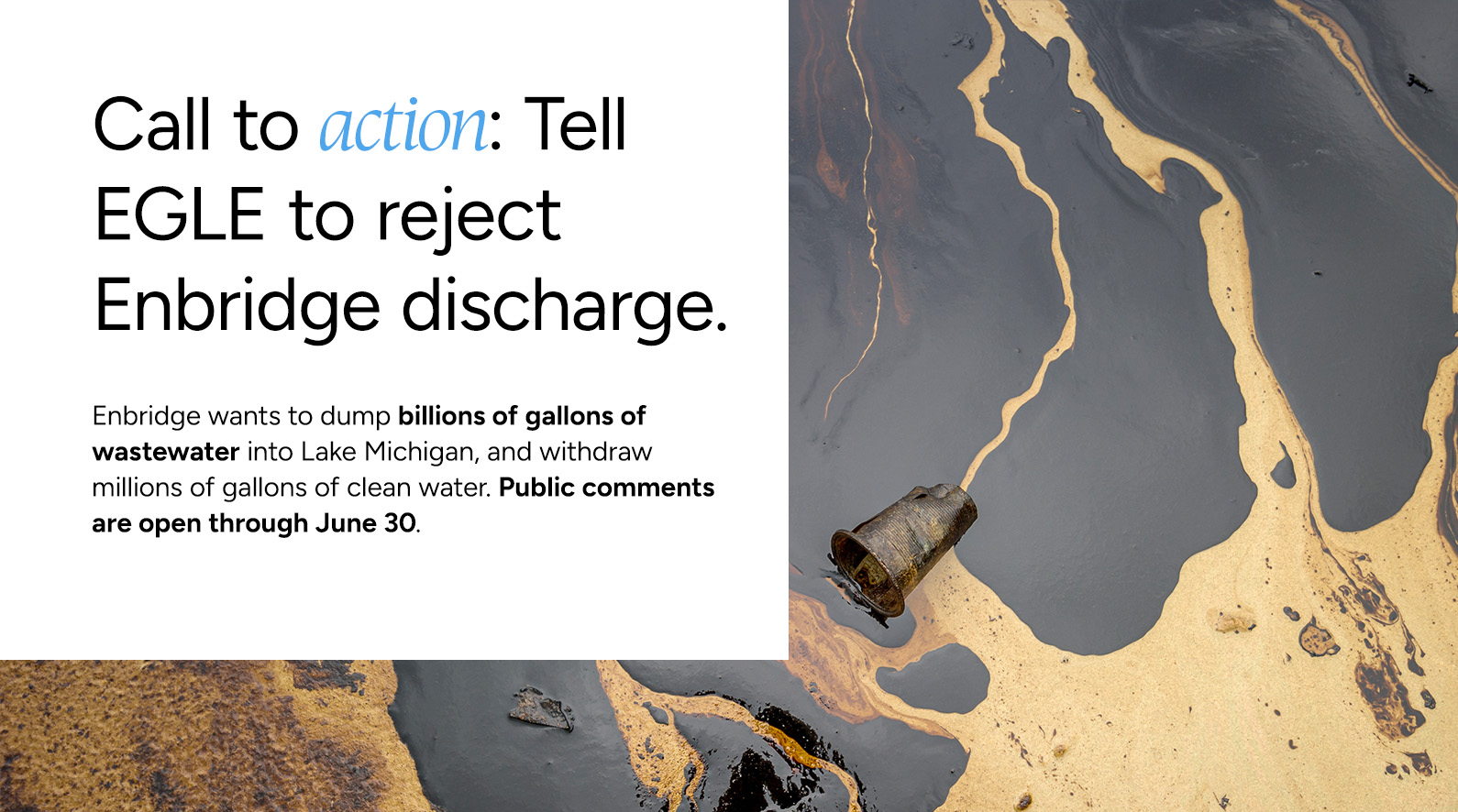
Last chance to speak up: Reject Enbridge’s discharge into Lake Michigan

What is happening:

Enbridge is requesting a permit from the Michigan Department of Environment, Great Lakes, and Energy (EGLE) for its proposed Line 5 pipeline tunnel under the Straits of Mackinac. If approved, the permit would allow Enbridge to:

  • Dump billions of gallons of wastewater into Lake Michigan — enough to fill 9 Olympic-sized swimming pools every day
  • Take up to 2 million gallons of water per day directly from Lake Michigan
  • Discharge chemical additives, chlorides, solids, as well as pollutants from the heavy machinery used to bore the tunnel (like metals, oil, and grease)

The discharges may also affect the temperature and pH of the water, altering its chemistry and stressing fish and other aquatic life.

What you can do:

EGLE is now taking public comments on Enbridge’s requested National Pollutant Discharge Elimination System (NPDES) permit, now and through June 30.

1) Tell EGLE and the State of Michigan to say NO to Enbridge’s plan to take millions of gallons of clean water from Lake Michigan, and discharge billions of gallons of dirty wastewater back into Lake Michigan. DEADLINE: June 30.

2) Attend the virtual public hearing on June 18 at 6:00pm. The public meeting will include a presentation and Q&A session, after which the public will have an opportunity to provide comments for the record. 

Enbridge must receive multiple state and federal permits for its troubled tunnel proposal. You may have already commented on a previous federal or state permit application for the tunnel (thank you!), but it’s important to comment on this new permit too.

This is likely our last chance to tell EGLE and Governor Whitmer to reject Enbridge’s dangerous and unnecessary tunnel project and deny Enbridge permission to pollute the Great Lakes.

Additional resources:

Michigan gets the risk, Canada gets the oil

What every Michigander needs to know about the Line 5 tunnel

REPORT: Enbridge's tunnel plan costly and ill-advised

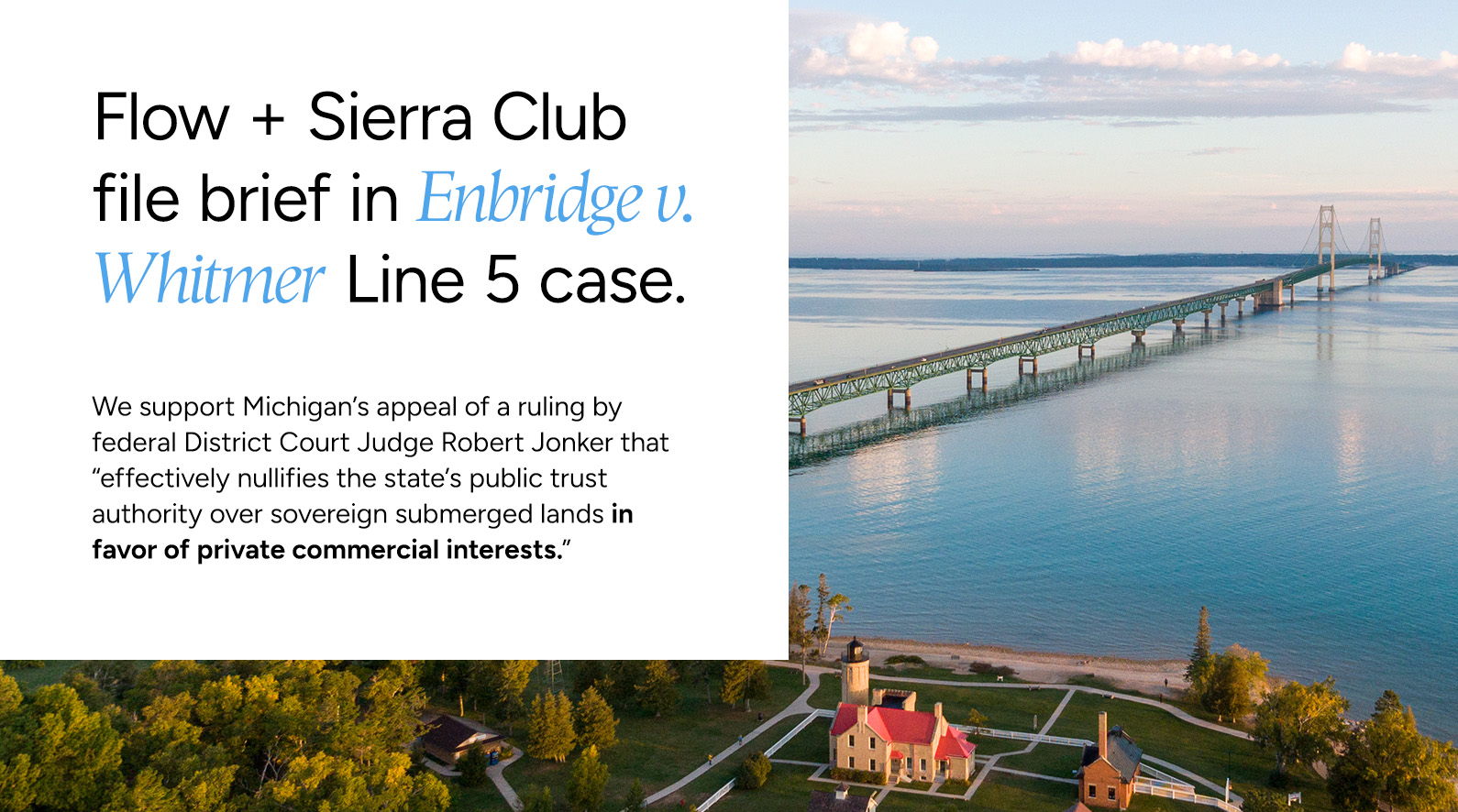
Flow and Sierra Club file joint amici brief in Enbridge v. Whitmer Line 5 case

Traverse City, Mich. — On May 11th, 2026, Flow Water Advocates (“Flow”) and Sierra Club filed an amici curiae, or friend of the court, brief in support of the State of Michigan’s appeal of a federal court’s failure to recognize and uphold an essential attribute of state sovereignty — the public trust doctrine. Flow and Sierra Club together represent thousands of Michiganders who stand up for the State’s right and duty to protect our publicly held lands in the Straits of Mackinac from the urgent threat to the waters and shorelines of the Great Lakes posed by Enbridge’s aging and vulnerable Line 5 pipeline.

Last December, federal District Court Judge Robert Jonker issued a ruling that, as Flow and Sierra Club explain in their brief, “effectively nullifies that state’s exercise of public trust authority over sovereign submerged lands in favor of private commercial interests — an extraordinary action never before sanctioned by the United States Supreme Court or any federal appellate court.” Flow and the Sierra Club argue further that the District Court committed legal error in holding that the State’s attempt to shut down Line 5 is preempted by the safety regulations in the federal Pipeline Safety Act of 1992 and interferes with the federal government’s conduct of relations with Canada and the administration of a 50-year-old treaty between the two countries.

Flow’s Senior Legal Advisor and Founder, Jim Olson said, “Public trust rights and interests foreclose any preemption because the State’s public trust responsibility is an essential element of statehood and can never be abrogated.”

“State sovereignty has to be protected here. The State of Michigan stood by its people and took action to protect Michiganders from the Line 5 pipeline. The safety of Michigan’s communities, lands, and waters is at risk every day this pipeline continues to operate,” said Anne Woiwode, leader, Sierra Club Michigan Chapter.

Flow and Sierra Club’s argument is grounded in the well-established, Supreme Court affirmation of the public trust doctrine (Ill. Cent. R. Co. v. Illinois, 146 U.S. 387, 453-55 (1892)) that supports revocation of a conveyance that was wrongfully granted in violation of the public trust. The State’s power to revoke isn’t just a power possessed by the state; it is an obligation when a conveyance (in this case, the easement) violates the public trust. As stated in Flow and Sierra Club’s brief: “Equating Michigan’s exercise of its public trust authority with enforcement of a “safety standard,” and thus preempted by 49 U.S.C. Section 60104(c), requires a semantical backflip that is contrary to the clear statement rule.”

Flow and Sierra Club also argue that the State’s easement revocation is not preempted by the foreign affairs doctrine; in fact, the 1977 Treaty governing transnational pipelines expressly provides the State with the authority to do what Michigan did in this case. The District Court’s interpretation of the treaty would “read a significant reservation of rights out of the treaty altogether.”

Five additional amici were filed in support of the state, including: The Great Lakes Business Network; a coalition of states led by Minnesota; a group of preemption, energy law, and environmental law scholars; a coalition of tribal nations led by Bay Mills Indian Community; and a group of foreign relations law professors.

###

Flow Water Advocates is an independent 501(c)(3) nonprofit organization based in Traverse City, Michigan. Our mission is to ensure the waters of the Great Lakes Basin are healthy, public, and protected for all. With a staff of legal and policy experts, strategic communicators, and community builders, Flow is a trusted resource for Great Lakes advocates. We help communities, businesses, agencies, and governments make informed policy decisions and protect public trust rights to water. Learn more at FlowWaterAdvocates.org.

Sierra Club is America’s largest and most influential grassroots environmental organization, with more than 3.5 million members and supporters. In addition to protecting every person’s right to get outdoors and access the healing power of nature, the Sierra Club works to promote clean energy, safeguard the health of our communities, protect wildlife, and preserve our remaining wild places through grassroots activism, public education, lobbying, and legal action. For more information, visit www.sierraclub.org.

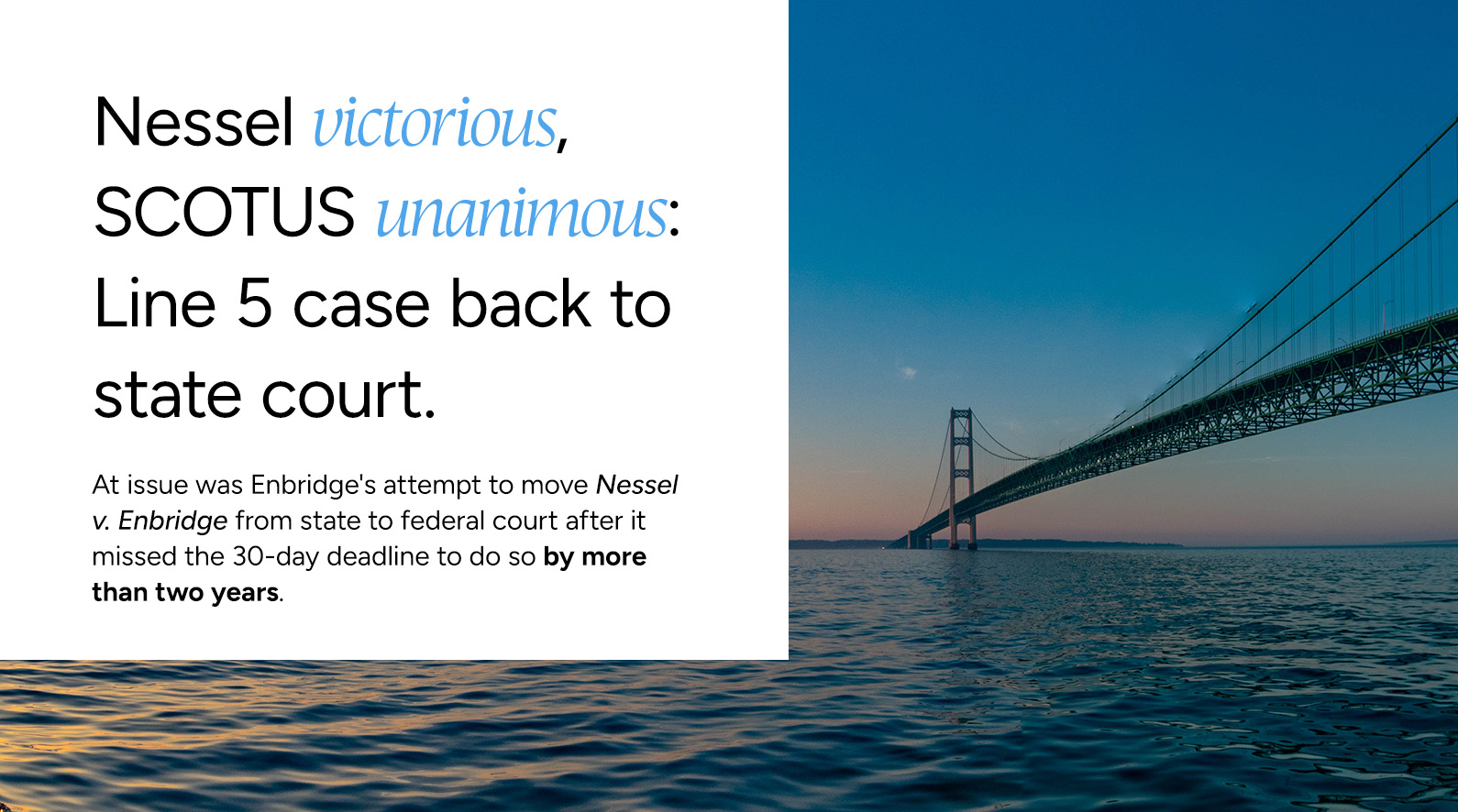
SCOTUS unanimous: Nessel v. Enbridge Line 5 case belongs in state court

Traverse City, Mich. — In a victory for the State of Michigan and its allies opposing the continued operation of the Enbridge Line 5 pipeline through the Straits of Mackinac, the Supreme Court of the United States has issued a unanimous decision that Nessel v. Enbridge will be heard in state rather than federal court. At issue was Enbridge’s attempt to move the lawsuit to federal court after it missed the 30-day deadline to do so by more than two years (in fact, Enbridge waited 887 days).

In June 2024, the federal Sixth Circuit Court of Appeals issued a decision to send Michigan Attorney General Dana Nessel’s 2019 lawsuit back to state court where it started. The Sixth Circuit held that Enbridge’s removal of the lawsuit to federal court was untimely and unjustified. Enbridge then appealed that decision to the US Supreme Court, which heard oral arguments in the case (Enbridge Energy, LP v. Nessel) on February 24.

In the opinion authored by Justice Sonia Sotomayor for the unanimous court, Sotomayor wrote that “Enbridge’s counterarguments are not persuasive.”

Flow Water Advocates has supported AG Nessel throughout the nearly-seven year procedural odyssey, including in its 2023 amicus brief urging the Sixth Circuit to remand the lawsuit back to state court.

“We are confident that once there is a trial on the merits in the proper state court venue, Attorney General Dana Nessel will successfully argue that the State of Michigan has the legal authority and duty to protect the Great Lakes from a potential catastrophic Line 5 pipeline oil spill,” said Liz Kirkwood, executive director of Flow Water Advocates. “Today’s unanimous decision from the US Supreme Court brings an end to Enbridge’s years-long delay campaign to move the case to a venue it perceives to be friendlier to the company’s ultimate goal of keeping oil profitably flowing through the heart of the Great Lakes — the large majority of which is bound for Canadian markets.”

###

Flow Water Advocates is an independent 501(c)(3) nonprofit organization based in Traverse City, Michigan. Our mission is to ensure the waters of the Great Lakes Basin are healthy, public, and protected for all. With a staff of legal and policy experts, strategic communicators, and community builders, Flow is a trusted resource for Great Lakes advocates. We help communities, businesses, agencies, and governments make informed policy decisions and protect public trust rights to water. Learn more at FlowWaterAdvocates.org.

Line 5 tunnel appeal: Join us in Lansing on March 11!

Flow Water Advocates and our allies are challenging the MPSC’s Line 5 tunnel permit in the Michigan Supreme Court, and you’re invited to a gathering and press conference in Lansing on March 11. 

Join in community at Lansing’s Central United Methodist Church at 9:00am to listen to oral arguments via livestream, make posters, and mingle with other Line 5 advocates. Space in the courtroom is very limited, so we’ve arranged this separate venue where everyone can listen and participate.

Following oral arguments, we’ll head to the Michigan Supreme Court steps for a press conference and show of solidarity. 

Coming from Traverse City? Oil & Water Don’t Mix has arranged for a bus to take folks down to Lansing at 5:45am; returning at 3:30pm.

Whether you plan to ride the bus or not, please register here for this event: